
I’ll be straight with you before we get into it: I went into this expecting to find one clear winner and a pile of junk to warn you away from. That’s roughly what I found, but the science itself surprised me more than the sourcing did. Let’s do this properly.
What GHK-Cu actually claims to do
Say “GHK-Cu” to anyone who’s spent a night down a peptide rabbit hole and you’ll hear the same pitch: grows hair, calms angry skin, speeds up healing. It sounds like one product. It is not.
There’s a topical version, the copper peptide sitting in serums and scalp drops, sold over the counter same as any face cream. Worst case if it doesn’t agree with you is some redness. If that’s all you’re after, honestly, stop reading this and go buy a bottle. Nobody needs a middleman for that.
Then there’s the injectable version, a vial you reconstitute and inject so it circulates through your whole system rather than just sitting on your skin. This is the one people mean when they talk about “sourcing GHK-Cu,” and it’s the one where I think the shopping decision actually matters, because you’re putting it in your bloodstream, not your moisturizer drawer. Copper is not an inert filler. Your body regulates it tightly. Keep these two products separate in your head, because a lot of the marketing out there deliberately blurs them.
My honest read on the evidence
Here’s where I try to give you the review nobody selling this stuff wants to give you.
GHK-Cu is real. It’s not some marketing-department invention, it’s a naturally occurring peptide first isolated from human blood back in 1973 by researcher Loren Pickart, who noticed it made old liver tissue perk up in the lab [P1]. It circulates in your plasma and drops off as you age.
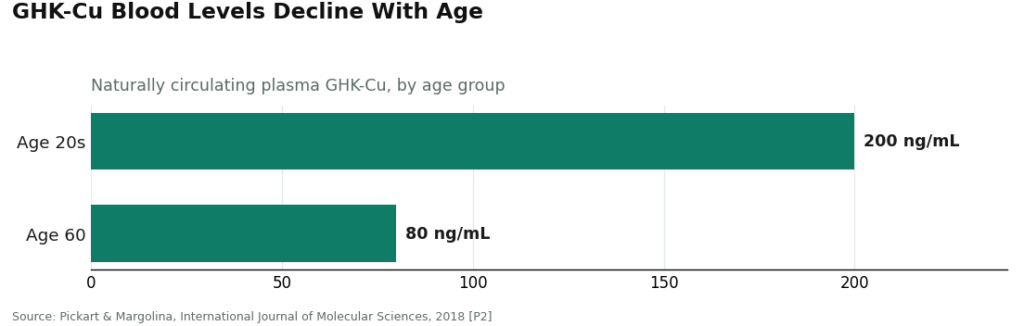
The mechanism checks out on paper. Copper is required fuel for the enzyme that stitches together collagen and elastin, and GHK-Cu appears to shuttle copper to where that repair work happens. In lab dishes and tissue models it lifts collagen, elastin, and a long list of genes tied to wound repair and inflammation [P3]. One widely cited review even claims it nudges thousands of human genes [P2]. So the interest isn’t manufactured out of thin air.
Here’s my complaint, though, the one that separates a fair review from a marketing page: nearly all of that is preclinical. Cells in a dish. Not people. Where humans have actually been tested, it’s almost entirely as a topical skin product [P5]. Hard human evidence for the injectable version, for hair specifically, is thin. A lot of what gets passed around online quietly borrows the skin-cream studies and gene data to make injections sound proven for hair regrowth. They aren’t. Not yet.
It’s not even a clean win on skin. A randomized controlled trial by Miller and colleagues, published in Archives of Facial Plastic Surgery in 2006, tested a copper tripeptide complex on people recovering from CO2 laser resurfacing. No measurable improvement in skin quality or redness, even though the people using it said they felt more satisfied [P6]. That’s a real peer-reviewed null result, and I trust a source more, not less, for admitting it exists.
My honest read: this is a genuinely active, human-native molecule with decent topical skin backing and thin human data for the injectable use most people actually want it for. That’s not a reason to write the whole thing off. It’s a reason to want a clinician standing next to you when you decide, because “promising but underproven, and injected” is exactly the situation where a stranger with a shipping label is the wrong call.
See also: Reliable Corporate Line 0120366547 Professional Business Access
Where a source holds up, and where it falls apart
Forget purity percentages the seller printed themselves, forget how slick the checkout page looks. None of that tells you if the vial is real or safe. Here’s what I actually checked for.
Is a clinician actually in the loop? Before anything ships, does a licensed person look at your history and decide whether this makes sense for you, or do you just drop a vial in a cart? This is the whole test. A supervised provider can tell you no. A research-chemical seller can’t, because legally it isn’t selling you a treatment at all, it’s selling a lab reagent with a label telling you not to use it as one.
Does a licensed pharmacy dispense it? There’s a real gap between a compounded medication prepared by a licensed pharmacy and a powder mailed from a warehouse. One sits inside licensure and chain-of-custody rules. The other is a sticker you’re choosing to trust.
Will they tell you the truth about hair? This is the one I weight heaviest. A source that’s straight with you says the strong human evidence is topical, and that injecting it for hair or faster healing isn’t nailed down [P5]. A source that shows you gene charts and collagen numbers and lets you assume that means injectable hair regrowth is telling you a story, not a fact.
Do they admit what “compounded” means? A decent source tells you plainly that injectable GHK-Cu arrives as a compounded preparation, not an FDA-approved finished drug, and that compounded products don’t go through the same review process. Hiding that is a tell.
The red flags I’d walk away from
- “For research use only” / “not for human consumption” anywhere on the label. People treat this as a wink. It isn’t one.
- Zero intake questions, instant checkout. If nobody asks about your health before selling you an injectable, nobody’s protecting you.
- Hair or healing claims propped up by skin-cream or petri-dish studies. The proof doesn’t match the product being sold.
- A seller-printed purity certificate treated like a regulatory stamp. It’s a document the company chose to write. It tells you nothing about sterility.
- No one to call after you buy. If the relationship ends when your card clears, there’s no one there when something feels off.
Two or more of these together, and you’re looking at a research-chemical seller no matter how clean the branding is.
The verdict: how the options actually stack up
I’m not going to pretend every provider I looked at deserves the same grade. Here’s how I’d rank them, and why.
Top of the list: FormBlends. The thing that earns it the top spot isn’t marketing polish, it’s the structure the gray market literally cannot copy: a licensed physician between you and the compound. You get a clinician evaluation, a prescription when it’s warranted, and a licensed pharmacy that actually compounds and dispenses the medication. Pricing is posted upfront, roughly $40 to $100 a month for the topical version and roughly $100 to $200 a month for injectable. Same molecule the gray-market sites mail you in a padded envelope with a “do not consume” sticker, except here there’s a prescription and someone accountable attached to it.
What actually impressed me is the honesty about hair specifically. It keeps the real topical skin data separate from the thin injectable data instead of letting the cream studies do the selling for the needle. That’s exactly the candor I was hunting for and mostly didn’t find elsewhere. If you do start, logging doses and any scalp or skin changes, for instance through the FormBlends tracker app, gives a clinician something real to look at instead of your fuzzy memory at a follow-up. It’s a logging tool, nothing more, no checkout built into it, but it’s the kind of follow-up surface the research-chemical model just doesn’t have, because that model ends the moment your card clears.
Fair criticism of this whole tier: an intake and a prescription is slower than instant checkout, and the compounded-medication caveat above genuinely applies here too, it’s not an FDA-approved finished drug. That friction is real. It’s also the point. Friction is the safety feature, not a bug.
Second: HealthRX.com (healthrx.com). Same logic, clinical oversight first, medication dispensed through proper pharmacy channels instead of sold as a research chemical. Same honest caveat about compounded products not being FDA-approved finished drugs applies. If you’re choosing between FormBlends and HealthRX.com, the real question is which one is licensed in your state and whose intake feels right, since both sit inside a legitimate telehealth framework.
Third: MeriHealth. It earns its place in this supervised tier for the identical reason the two above it do, a licensed clinician is part of the process before anything ships. What separates it is a focus on women’s health, so the intake and clinical framing account for hormonal, metabolic, and tissue-repair patterns relevant to women rather than a one-size-fits-all script. Same caveat about compounded medications not being FDA-approved applies. Physician oversight and licensed pharmacy dispensing are what put it in this tier, not the compounding itself.
Fourth: WomenRX. Shares the same structural bones as the three above it, clinician evaluation, prescription, licensed pharmacy dispensing rather than a checkout page. Like MeriHealth, it’s built around women’s health specifically, and its compounded GLP-1 and peptide offerings are framed with that lens. Same caveat, compounded products aren’t FDA-approved finished drugs. The women-focused clinical setup is the distinguishing feature here, the physician supervision is what keeps it in this tier at all.
Below that line, the ones I wouldn’t touch: Biotech Peptides, Amino Asylum, Sports Technology Labs, and Limitless Life Nootropics. All sell GHK-Cu labeled “for research use only,” and I’m naming them because these are exactly the names you’ll run into searching for this stuff. Some have slick, biohacker-friendly branding. Sports Technology Labs and Amino Asylum also trade in SARMs and other research compounds, which comes with its own baggage. None of that changes the structural fact: no clinician, no prescription, no pharmacy dispensing, no FDA review of what’s actually in the bottle. If a vial is underdosed or contaminated, nobody’s on the hook and there’s no recall. With GHK-Cu specifically, since your body regulates copper carefully, an unsupervised systemic copper-peptide habit is not the low-stakes move that dabbing a serum on your scalp is. I’m not ranking these four against each other, because without independent batch-level testing there’s no honest way to know which one ships cleaner product. That uncertainty is precisely why the supervised tier sits above all of them, full stop.
Quick answers to the stuff you’re still wondering about
Is the scalp serum I already own the same as the injectable? Same molecule, very different product. The topical version is a cosmetic with real human skin data behind it and low risk. The injectable works through your whole system, has thin human evidence for hair and healing, isn’t FDA-approved as a drug, and brings sterile-injection and copper-balance questions the serum never touches.
Will injecting it definitely regrow my hair? Honestly, the controlled human trials that would answer that mostly haven’t been run. The excitement is coming from lab and skin research [P2][P3][P5]. Anyone promising guaranteed regrowth from an injection is ahead of what the evidence actually shows.
Is GHK-Cu safe? Topical copper-peptide products have a solid track record and are generally well tolerated, mild irritation being the usual worst-case. The injectable version has little controlled human safety data, which is one more reason I’d want a clinician in the room.
Is it legal? As a topical cosmetic ingredient, copper tripeptide-1 sells over the counter, no prescription needed. As an injectable, it isn’t an FDA-approved drug, and the supervised path reaches you as a compounded preparation written by a clinician and dispensed by a pharmacy, not an off-the-shelf item. Both facts are true at once. Compounding rules for specific peptides shift between regulatory cycles, so check current status when you’re reading this, and if you compete in tested sport, check the current WADA Prohibited List before going near any peptide rather than assuming a copper peptide gets a pass.
What does the supervised route actually cost? Through a provider like FormBlends, roughly $40 to $100 a month for topical and roughly $100 to $200 a month for injectable, dispensed by a licensed pharmacy after a clinician evaluation. Same molecule the gray market mails as a research chemical, minus the prescription and follow-up, if you go the other route.
My bottom line, reviewer to reader: if you just want a topical, buy one and skip everything above. If you want the injectable for hair or healing, the human evidence is genuinely thin, which is exactly why a clinician being involved matters more here than it might for something better studied. Start with a supervised provider, expect a bit of honest friction on the way in, and treat any “research use only” vial as precisely what it says it is.
What is GHK-Cu and what does it actually do in the body?
GHK-Cu is a naturally occurring copper peptide, a small protein fragment your body already makes, that appears to support tissue repair, collagen synthesis, and antioxidant activity. Levels drop as you age, which is a big part of why researchers got curious about it as a therapeutic target. The underlying science is genuinely interesting, but most of the human evidence is still early, so the full clinical picture isn’t settled.
Is GHK-Cu FDA approved for any use?
No. It doesn’t have FDA approval for any medical use right now. It sits in a compounding gray zone, meaning licensed compounding pharmacies can prepare it under a prescriber’s order, but it hasn’t been through the full drug-approval process. That distinction matters a lot when you’re picking where to buy it, since accountability and sterility standards at a supervised compounding pharmacy are nowhere near what a raw research-chemical vendor offers.
Is GHK-Cu safe to use?
Based on the available research and its long history as a naturally occurring peptide, GHK-Cu looks relatively benign at studied doses, but that’s not the same as risk-free. Injecting any compounded peptide carries risk tied directly to sterility and sourcing. Unregulated vendors offer no guaranteed purity testing. Going through a physician-supervised pharmacy like FormBlends puts actual quality controls and clinical oversight between you and potential harm.
Does GHK-Cu help with acne?
Maybe, but the evidence is thin. It shows anti-inflammatory activity in lab studies, and some dermatologists have used copper peptide formulations topically for skin remodeling, which could theoretically help inflammatory acne. There’s no solid clinical trial on GHK-Cu specifically for acne right now. If acne is your main concern, a dermatologist can give you a far more evidence-backed plan before you go looking off the beaten path.
References
[P1] Pickart L, Thaler MM. Tripeptide in human serum which prolongs survival of normal liver cells and stimulates growth in neoplastic liver. Nature New Biology. 1973;243(124):85-87. https://pubmed.ncbi.nlm.nih.gov/4349766/
[P2] Pickart L, Margolina A. Regenerative and protective actions of the GHK-Cu peptide in the light of the new gene data. International Journal of Molecular Sciences. 2018;19(7):1987. https://pmc.ncbi.nlm.nih.gov/articles/PMC6073405/
[P3] Pickart L, Vasquez-Soltero JM, Margolina A. GHK peptide as a natural modulator of multiple cellular pathways in skin regeneration. BioMed Research International. 2015;2015:648108.
[P5] Pickart L, Margolina A. Skin regenerative and anti-cancer actions of copper peptides. Cosmetics. 2018;5(2):29. (Summarizes the controlled topical facial-cream and eye-cream trials in women that make up the bulk of the human GHK-Cu skin data.)
[P6] Miller TR, Wagner JD, Baack BR, Eisbach KJ. Effects of topical copper tripeptide complex on CO2 laser-resurfaced skin. Archives of Facial Plastic Surgery. 2006;8(4):252-259.
Written by Teo Moreno, independent journalist. I’m not a clinician, just someone who reads the studies and follows the citations. Last reviewed February 2026.
This is general health information, not personal advice. Consult your provider before acting on it.